Connected Driving
Software is still waiting for metal, and software-defined vehicles are paying for it
HERE Technologies — 12 November 2026
9 min read
13 November 2026
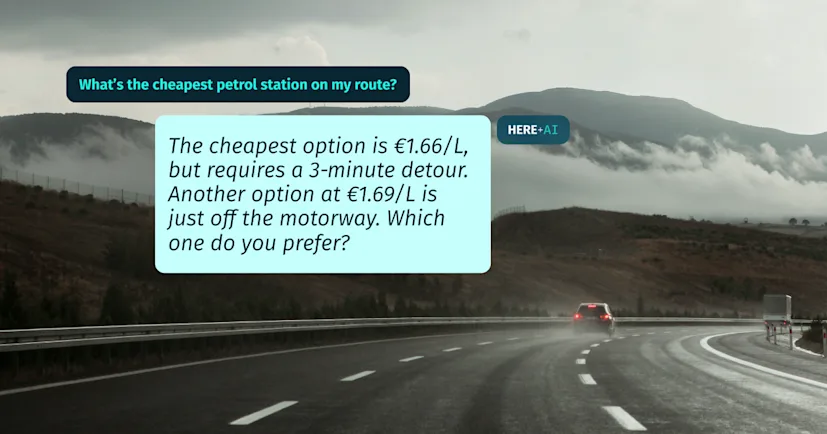
Ask a language model to find the closest bakery to Gunnersbury Park in London and it will give you a confident answer. Check that answer against a map, however, and you may find it’s nowhere near the closest. That’s because the model has inferred proximity from reviews and descriptions rather than calculating actual distances across the road network.
For anyone building agents that route trucks, plan deliveries or guide drivers, that gap is the real obstacle. The answer arrives fluent and plausible, so nobody notices the error until a vehicle ends up in the wrong place. Closing it is the central job of geospatial AI, and it starts with deciding where the location decision gets made.
Language models predict the next word. Distance, direction and reachability are geometric properties, so a model can only describe space through the words people have written about it.
Take navigation. Asked for directions between two London landmarks, a model may produce plausible step-by-step instructions. Compared with the actual road network, those paths often cut through streets incorrectly, miss available routes or miscalculate distance. A route is a calculation across a graph of millions of road segments, so a sequence of sentences can't stand in for it.
Midpoint questions fail the same way. Finding an Italian restaurant halfway between Notting Hill and Westminster takes three steps: geocode both places, calculate the midpoint, then evaluate candidates against it. Skip those steps and the model guesses from text patterns. Live conditions add another layer, since an ETA from Luton to London built on typical travel times says little about the traffic you face right now.
A confident wrong answer is more expensive than an obvious failure. An error message sends someone to fix the problem. A plausible route, ETA or nearby-place recommendation gets acted on. The cost shows up later as lost time, a missed delivery window or a customer who stops trusting the experience.
Agents make this worse by chaining decisions. One slightly wrong distance feeds a wrong ETA, which feeds a wrong schedule. By the time anyone notices, the mistake has spread through every step that depended on it.
Dynamic conditions raise the stakes again. Traffic, closures and restrictions change by the hour, and a model working from training data or retrieved text reflects the past. Reliable location reasoning needs current road information and a calculation that uses it.

Read more: What is geospatial grounding in AI?
Grounding means giving an AI model outside sources, like documents, records, or data, to check its answers against or add to them, rather than relying only on what it learned during training. Most people working on this problem use that word for it, and it is a useful one. The trouble is that grounding only kicks in after the model has already done its reasoning, so any mistake gets caught late. And even then, the lookup can pull the wrong record or the wrong source, and the model can still misstate a fact even when the right one was right there.
For location questions, the model should not do the spatial reasoning at all. That is the idea behind HERE Location Reasoning, the spatial execution layer that takes the location decision away from the model and returns a result the agent can act on.
Picture this: find the least-traffic route to the airport at a specific time, hit an arrival deadline, and stay within certain route constraints. HERE Location Reasoning breaks that request into structured geospatial execution steps and works through it with real spatial logic against HERE's authoritative data. The agent gets the answer. It does not have to improvise one.
Three things matter most to the people running these systems.
Determinism: give the layer the same inputs and constraints and you get the same answer, every time, across different models and workflows.
Context: the layer returns validated answers complete with alternatives, tradeoffs, and constraints, so an agent can point to the best option and explain its reasoning.
Optimization: multi-step queries travel one structured path instead of bouncing between tools, which cuts unnecessary tool calls, API usage, and latency.
Cost is the second worry after accuracy. When a model has to work out which tools to use and in what order, it burns context and tokens, and each extra round trip adds latency. Moving the spatial work into the execution layer reduces token usage and API calls, so the right answer arrives faster.
Because the layer handles the location decision, you can also right-size the model that handles everything around it. Integration time shrinks too. HERE Location Reasoning is model and framework agnostic, so you don't retrain models, redesign prompts or rebuild orchestration logic to add it. Your team spends less time writing custom spatial logic and more time moving from experiment to production.
That shift matters most for the leads who own delivery dates. Each custom spatial workaround is another thing to test, maintain and explain when an answer looks off. A dedicated layer replaces that growing pile of exceptions with one consistent path. Your roadmap can then add agent use cases without reopening the question of whether location answers hold up.

Read more: Why AI needs a map of the real world
Four checks separate the two when you evaluate any approach for your agents.
Ask whether the system computes or describes. A real answer comes from geocoding places, measuring across the road network and testing constraints. A plausible one comes from text about those places.
Run the same request twice, then run it through a different model. If the answers change, you have a probabilistic system and every downstream step inherits that variation. HERE Location Reasoning is built so the same inputs and constraints produce the same answer.
Look for the reasoning behind the answer. A result that arrives with alternatives, tradeoffs and constraints is one your team can review, defend and improve. A bare answer leaves you guessing.
Count the work your agent does to get there. Every extra tool decision costs tokens and adds a round trip. A structured execution path keeps that overhead low as you add use cases.
An execution layer is only as good as the intelligence it computes on. HERE Location Reasoning draws on location intelligence that goes beyond consumer maps, including truck restrictions, automotive-grade road data and real-time traffic. For a fleet or logistics team, that separates a route that looks fine from one a truck can drive.
Privacy sits in the design as well. Using HERE Location Reasoning doesn't result in collection or monetization of your data, and our data-minimization approach applies anonymization by default.

Read more: Why LLMs understand language but not space
As AI agents move from answering questions to acting in the physical world, location is where "sounds right" stops being good enough. A wrong turn, a missed delivery window or a misrouted vehicle has a real cost, and that cost lands whether the agent spoke with confidence or not. The gap between a fluent answer and a correct one is invisible right up to the moment it is not.
The lesson reaches beyond maps. Reliability will not come from better prompts or from checking answers after the fact. It will come from architecture, from deciding which parts of a task a model should reason about and which it should hand to a system built to compute them. Models are strong at understanding intent and language. Geometry, time and traffic belong to something that calculates them from authoritative data.

HERE Technologies
Share article
HERE Technologies — 12 November 2026
Maja Stefanovic — 03 November 2026
Tomi Agócs — 02 October 2026
Get the latest on location technology, AI innovation and HERE product updates delivered straight to your inbox.
What you'll get:
Expert insights on agentic AI, spatial reasoning and location technology
Early access to HERE product updates, demos and resources
Practical guidance on building location-aware AI that works in the real world