Insights & Trends
Thanks to HERE Location Reasoning, your AI knows where it is
HERE Technologies — 27 October 2026
7 min read
12 November 2026
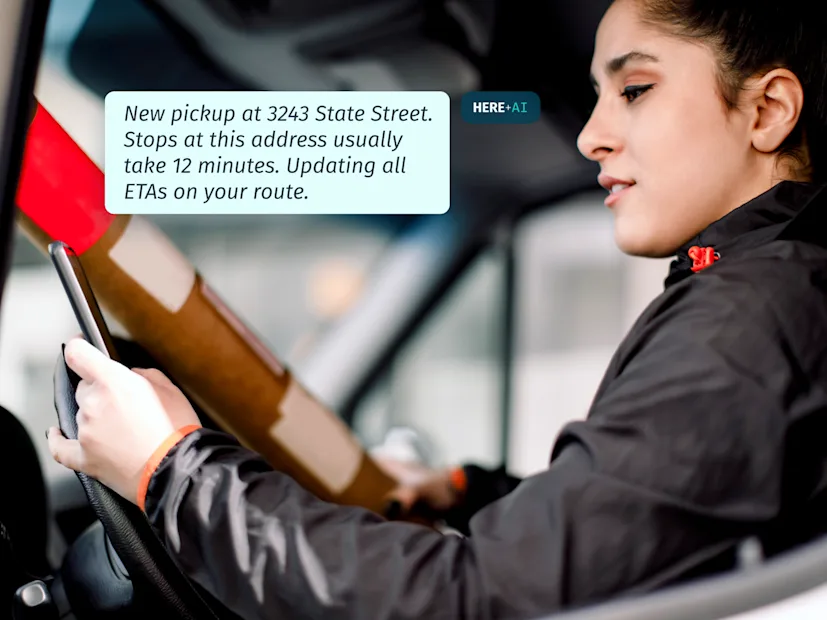
A dispatcher can build a perfectly optimized route, but if the driver's turn-by-turn directions reflect a closed road, a missed entry point or a loading dock,the vehicle cannot fit through, that plan falls apart the moment it matters most.
Here is the typical starting point: dispatch assigns a driver an optimized set of delivery stops. The driver opens the app. But a stop order is not yet a set of directions. To make the plan usable on the road, the app needs the assigned destinations and routing requirements, and then it needs navigation for each leg of the journey between them.
For an operations team, that handoff is the whole decision.
Dispatch already figures out which stops to visit and in what order. The real question is whether that plan survives the journey from dispatch to driver in one piece, or whether drivers end up choosing their own roads once they are moving.
This is because the assignment a driver receives is a list of stops, often with time windows and vehicle restrictions attached. It says where to go and in what sequence. It does not say which street to take or where to turn.
That work belongs to routing and navigation, which are separate jobs entirely.
Think of the tour as an itinerary and navigation as the directions that carry a driver from one stop to the next. An itinerary names destinations; navigation determines the roads to take. The two sound similar but answer completely different questions.
An optimized stop order only answers which destination comes next. It says nothing about which road reaches that destination, which lanes a truck may use or which turn restrictions apply along the way.
A dispatcher's plan is an outcome. A driver's route is a decision still waiting to be made.
Without that transfer step, a driver holding only a stop list still has to choose a path on their own, turn by turn. Two drivers given the same sequence of stops can legitimately end up on completely different roads.
This is where HERE Tour Planning, HERE Routing and HERE Navigation capabilities add a layer of planning designed to optimize the entire route, not just reach the next stop.
A dispatcher builds the tour in HERE Tour Planning, working out which stops a vehicle visits and in what order. HERE Routing calculates the road-level path between each pair of stops, taking into account the map data and vehicle restrictions that apply.
HERE Navigation capabilities then take that path and guide the driver turn by turn to each destination, turning planning and navigation into a deliberate step in that sequence, not something that happens on its own.
Each job works on a different input, produces a different output and runs at a different moment.
Tour planning happens before the shift starts. It takes a set of deliveries, time windows and vehicle constraints, and returns an ordered list of stops. Routing runs once per leg and again whenever conditions change. It takes two stops plus the vehicle's restrictions and returns a road-level path.
Navigation runs live while the vehicle is moving. It takes that path and the driver's current position and returns the next instruction, such as which lane to take or where to turn.
Because the output of one job is the input of the next, a gap at any point leaves the one after it working with less than operations intended. These are three separate jobs, and finishing the first does not finish the other two.
A planned fleet tour with a perfectly optimized stop order can still reach a driver with no information about approved roads for a loaded truck or turn restrictions near a delivery dock.
What closes that gap is information carried forward at each step, not just a correct stop sequence.
HERE Tour Planning is built to produce an optimized stop order from a set of deliveries and constraints. HERE Routing and Map Data inform the path the vehicle takes. But those capabilities describe what is available to an integrated workflow, not a built-in handoff that happens automatically.
Picture the same assignment moving through a working fleet system, all the way from dispatch intent to driver guidance.
The dispatcher completes the plan for a driver's shift and sends it to the driver app. The app receives the stops in order, ready to act on. Each stop comes with its delivery window, showing when it must be served and any vehicle restrictions that affect which roads the truck can use.
For each leg of the journey, routing calculates a path to the next destination using current map data and any relevant restrictions. Navigation then presents that path as turn-by-turn directions for the road ahead, one instruction at a time.
How well that sequence holds together depends on how the app is built, which brings the story back to where the plan begins.
A plan is only useful once it reaches the driver. That means the stops, delivery windows and vehicle restrictions have to travel from HERE Tour Planning into HERE Routing, so the right road-level path is calculated, and then into HERE Navigation, so the driver is guided by the same constraints operations approved. Each step has to actually use what the previous step passed along.
When that chain holds together, the driver turning onto the road is not improvising. They are following the plan operations built.

Maja Stefanovic
Senior Writer
Share article
HERE Technologies — 27 October 2026
Louis Boroditsky — 24 August 2026
Louis Boroditsky — 30 October 2026