
Fleet Management
Debate worth having: can women reshape logistics leadership?
Louis Boroditsky — 07 October 2026
5 min read
31 March 2026
The commercial electric vehicle market is expected to grow by nearly 20% year-on-year until 2032, ABI Research told HERE360.
Leading the charge are light- and medium-sized vehicles in the middle- and last-mile operations. Urban emissions rules, reductions in EV costs and improvements in technology are driving the adoption.
For fleets, the challenge is no longer simply adding EVs. It’s managing how the EVs work in their fleets. “There is a fundamental shift taking place,” said Adhish Luitel, research director at ABI Research. “We’re seeing a lot more mixed fleets and they come with complex requirements.”
One reason mixed fleets are becoming the norm is because different vehicles suit different routes and jobs. EVs are often best suited to shorter routes with reliable charging infrastructure. Longer routes, or those where charging infrastructure is limited, are better supported by hybrid or internal combustion engine (ICE) vehicles.
For fleets, the challenge is juggling the best vehicle for the right route and managing that alongside dispatch management, routing and delivery schedules.
“The biggest challenge is really managing two different types of assets, along with dispatch management and routing, and co-optimizing them based on the available charging infrastructure,” added Luitel.
That complexity is especially noticeable in the last mile. Last-mile delivery typically involves a high number of stops and a strong need for route accuracy. Fleets need to manage that alongside planned charging or refueling stops.
“It comes down to managing a diverse set of vehicles and assets, with different constraints for ICE and EV vehicles, and then managing routes, shifts, refueling and charging around those nuances,” said Luitel.
“Last mile is now, and will increasingly be, more geared toward EV-based use cases,” he added. So planning is key. But this is where current fleet management tools and systems are coming up short.
“With mixed fleets, and especially EV-dominated fleets, you need more precise range modeling,” said Luitel. “You need battery and range management, so you know when a vehicle will need charging and how long it needs to charge before it can get back on the road.”
Charging time, range predictions, charging stops and payload-adjusted energy consumption also need to be taken into account, because an EV can’t be treated as an ICE vehicle with a different powertrain.
“That level of granularity is not there in many current solutions,” added Luitel.
The challenge becomes even harder once vehicles are on the road. Congestion, road closures, detours and time-based urban restrictions can disrupt routes in real time and have a knock-on effect on ETAs and charging schedules.
“Proper AI integration here is crucial,” said Luitel, particularly in combing these real-world variables with better route management and charging stops.
That’s the gap HERE is aiming to address with its upgraded Tour Planning. Designed to support fleets through the EV transition, HERE Tour Planning combines AI-powered predictive intelligence with EV-ready optimization in a single planning tool.
It can improve planning and routing efficiency for electric vehicles by up to 20% and improve ETA accuracy by up to 15%. It does this by using a physical consumption model rather than broad assumptions. Fleet operators can also input private charge point locations or draw on HERE’s public database of more than 1.9 million EV charge points and attributes.
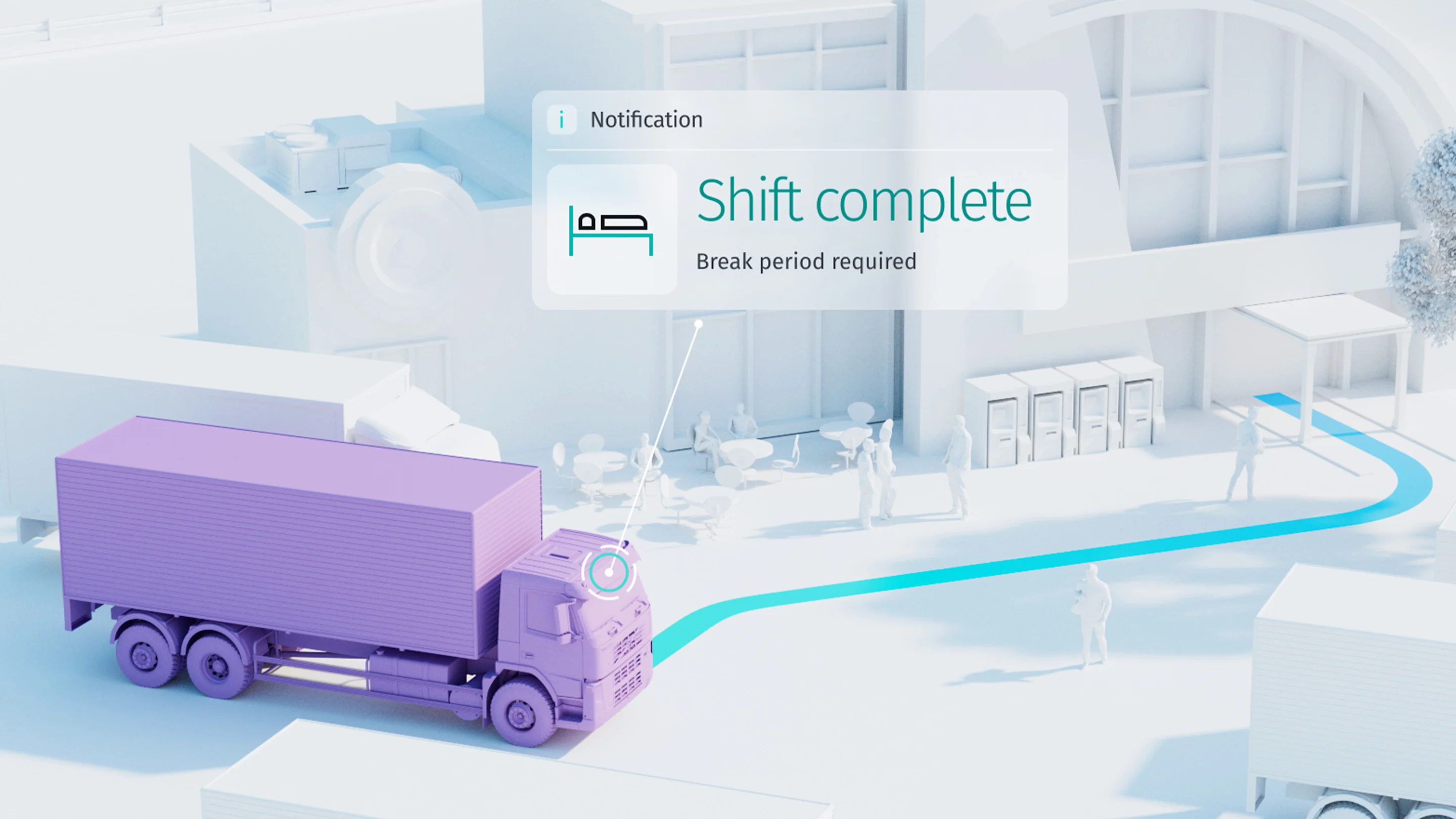
Crucially, HERE Tour Planning is designed around the realities of mixed-fleet operations. That includes planning around charging downtime, driver shifts, breaks and rest periods, so that fleets can build routes that are feasible and efficient.
“That level of multifaceted optimization can be a powerful tool for last-mile and middle-mile fleets,” said Luitel.
As he points out, if a vehicle is already charging, “why not align that with a change in driving shifts or during driver rest times?” That, he said, is the kind of route optimization that can make a real difference in last- and middle-mile operations.
For fleets, the takeaway is clear. Mixed fleets are no longer a future scenario; they’re already a reality. The businesses that succeed will be the ones that can make better use of real-time data, understand the different demands of EV and ICE vehicles, and plan around those differences with much greater precision.
Many operators are still relying on mainstream tools that are strong on conventional route management but weaker on the deeper requirements of mixed-fleet planning. “That’s where the biggest market gap is,” said Luitel.

Ian Dickson
Contributor
Share article
Louis Boroditsky — 07 October 2026
Louis Boroditsky — 06 October 2026
Louis Boroditsky — 10 September 2026
Why sign up:
Latest offers and discounts
Tailored content delivered weekly
Exclusive events
One click to unsubscribe