Connected Driving
EV interest is rising. Now the ownership experience must deliver
Ian Dickson — 21 September 2026
7 min read
18 March 2026
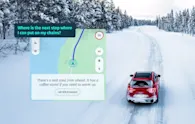
You are driving down a highway at night in your electric vehicle (EV). The dashboard says you have plenty of range left, and the navigation system shows your destination is well within reach. So you relax, turn up the music and enjoy the drive.
Then the road begins to climb. The temperature outside drops. Suddenly, the number on the dashboard starts falling faster than the miles you are actually traveling.
The calm feeling turns into unease. You realise the car did not fully account for the steep hill, the cold air or the extra heating needed to stay warm. Now you are watching the range tick down, doing the mental maths and wondering if you will make it. What started as an easy drive has turned into a race against the battery.
This is a very common nightmare scenario for EV drivers.
When a driver cannot trust the numbers in front of them, every trip becomes a source of stress. Because inaccurate EV range calculation is not just an inconvenience. It's a vulnerability.
In fact, the fear of being stranded without access to a charger is a leading barrier to EV adoption. We explore what's causing it and how location technology can help fix it.
Most electric vehicles on the road today estimate range by analysing the driver’s recent driving history. The system assumes that how you drove before is how you will drive today.
So if your recent trips were slow, stop-and-go journeys around the city, the car assumes similar conditions ahead and projects a relatively generous range.
But driving conditions change constantly.
A calculation based on yesterday's city commute is not going to be helpful in predicting the energy your car will need for an out of town trip you have planned for tomorrow.
This is because the number your car displays is static and doesn't react to the changing conditions of the world around it, sometimes until it's too late.
This leaves drivers with the uncertainty of planning trips based on inaccurate data. And this uncertainty is why so many people still hesitate to switch from gas to electric.
Cold and heat play a huge role in how far your electric vehicle can travel. It's also the most unpredictable variable because batteries rely on chemical reactions that slow down in the cold.
Then there is the heater and air conditioning (AC).
To warm you up or cool you down, your vehicle uses power from the same battery that makes it drive. Many algorithms that calculate range ignore these energy drains when assessing the distance you can cross, focusing exclusively on how much battery is used for the drive.
Topography plays a massive role as well.
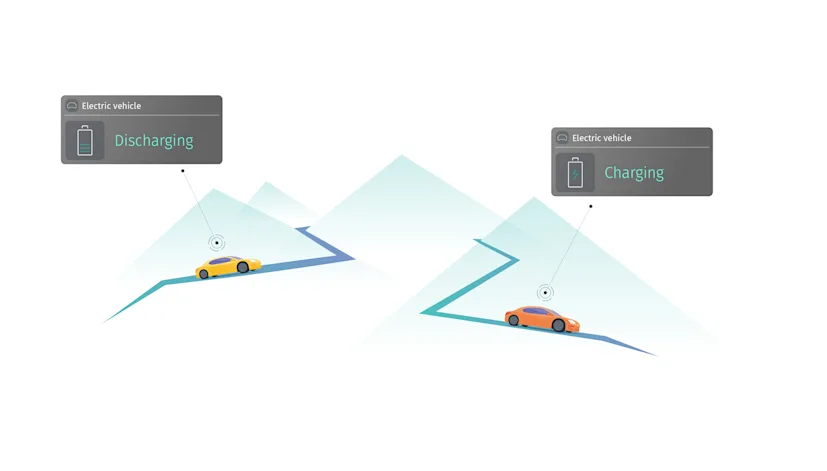
Driving up a long, steep hill requires far more energy than driving on a flat road. While regenerative braking helps recover some energy on the way down, the initial climb can deplete a battery at quite a high rate.
If the car's software doesn't know the road ahead is steep, it won't take this factor into the range calculation.
Traffic also matters. Although stop-and-go traffic can be good for EVs due to regenerative braking, high-speed highway cruising is not. This is mostly because air resistance increases with speed.
Driving at seventy miles per hour uses much more energy than driving at fifty. If your car isn't accounting for speed limits and traffic flow, any range prediction is just a guess.
The risks of driving without knowing the exact range of your car are clear, but there is a solution to all this uncertainty: data.
A car that runs on advanced data is a car you can rely on. And this is where location technology plays a key role.
Solutions that rely on location intelligence, such as HERE EV Routing take into account more than just the distance a car is about to travel. They analyze all the details of the journey before you even start the car.
Specifically, location tech looks at road geometry, such as hill steepness and curve sharpness, factors in historical and real-time traffic speeds and takes into account temperature and weather forecasts along your route.
By processing this data, the vehicle calculates a "dynamic range." This offers a realistic prediction of the energy your car will use to get from one point to another, showing exactly how much battery you will have once you reach your destination.
It removes the surprise and the fear of the unknown, giving drivers more confidence and stress free journeys.
Inaccurate range calculation might be the biggest cause of range anxiety, but it's not the only issues EV drivers are facing.
There is nothing worse than arriving at a charging station with 2% battery, only to find the charger is broken or occupied. You might not be stranded in the middle of a highway but you're still wasting time, or becoming stuck if the charger is broken.
Location technology helps with this too.
Solutions such as HERE EV Charge Points addresses this issue by providing dynamic information about charging networks, showing the connector type, the charging speed and most importantly, the real-time availability of the station.
When your car knows your precise range and the exact status of chargers ahead, it can make smart decisions such as suggest a charging stop that minimizes your detour time.
It can also ensure you arrive at a station that is working and compatible with your vehicle. This creates a safety net for the driver, ensuring that a long road trip does not end on the back of a tow truck.
Accurate EV range calculation has long been a challenge, but smarter data and advanced insights are offering EV drivers more accuracy and reliability and turning range anxiety into a thing of the past.
With continued advancements in technology, the future of electric mobility looks promising, allowing drivers to make the switch to electric without fear of ever being stranded again.

Maja Stefanovic
Senior Writer
Share article
Maja Stefanovic
Senior Writer
Ian Dickson — 21 September 2026
Louis Boroditsky — 22 July 2026
Louis Boroditsky — 17 July 2026
Get the latest on location technology, AI innovation and HERE product updates delivered straight to your inbox.
What you'll get:
Expert insights on agentic AI, spatial reasoning and location technology
Early access to HERE product updates, demos and resources
Practical guidance on building location-aware AI that works in the real world