
Fleet Management
Debate worth having: can women reshape logistics leadership?
Louis Boroditsky — 07 October 2026
7 min read
06 October 2026
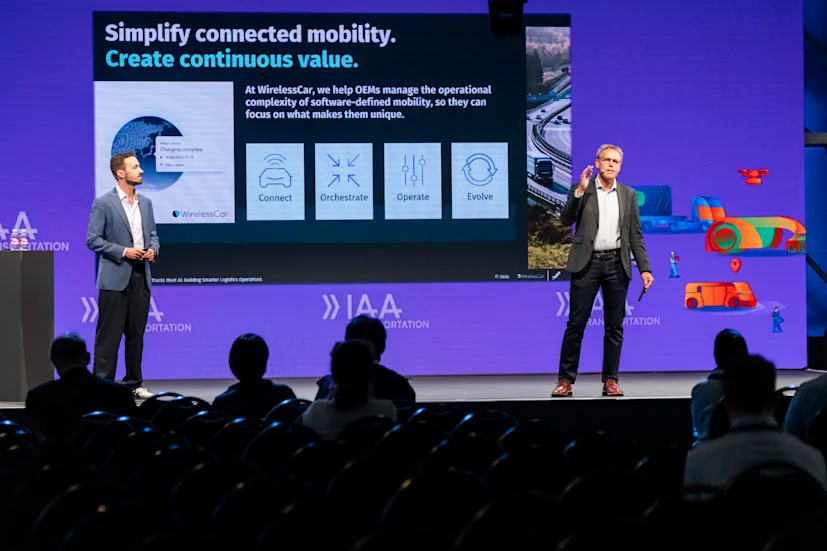
Marvin Ruf, Senior Business Development Manager at HERE Technologies, and Niklas Florén, Chief Executive Officer at WirelessCar, joined forces for a session called "Connected trucks meet AI: building smarter logistics operations."
Their timing made sense. Florén told the audience that 15 million connected trucks are now driving on European roads, up from just one million only a few IAAs ago. The question, he said, is no longer how to connect a truck. It's how to turn that connection into something useful.
Fleets already have dashboards showing fuel use, maintenance schedules and driver behavior. Yet Florén pointed out that many operators still call the driver directly when they need an answer, or worse, find out about a delay only when a customer calls to complain. The data exists. The decisions built on top of it often don't.

Ruf explored how HERE's digital twin of the physical world and AI are reshaping logistics, with a live demo evaluating routes between Hamburg and Naples.
This is where location intelligence enters the picture. HERE builds what Ruf calls a digital twin of the physical world, tracking roads, traffic, weather, charging infrastructure and low emission zones in real time. On its own, vehicle data can only describe what's happening inside a truck. Location data explains what's happening around it, and that context changes everything.
WirelessCar supplies the connected vehicle layer, capturing thousands of data points per truck every minute, from speed and temperature to driver activity. Bring those two data sources together and you still only get a fuller picture. AI is what acts on it.
During the session, Ruf demonstrated a logistics AI agent that evaluated route alternatives between Hamburg and Naples, weighing cost, delivery speed and emissions, then explained its reasoning rather than simply delivering an answer. That transparency, Florén added, is what makes a recommendation trustworthy enough to act on.

Fifteen million connected trucks are already on European roads.
In a recent follow-up interview, Florén returned to a theme he raised repeatedly on stage: collaboration, not technology, is the real barrier to progress. "HERE cannot solve this. WirelessCar cannot solve this. The fleet operator cannot solve this, the automakers cannot solve it," Florén told HERE360. "It's when we're working all together."
Asked what stands in the way, Florén said the hardest part is finding a structure where every partner benefits. "Finding the right way to collaborate so we create that win-win is sometimes the trickiest part," he said. Once that structure exists, he added, the rest of the pieces tend to fall into place.
Florén was equally clear that AI won't replace the fleet operator's role, only change how it's performed. "I don't think the overall responsibility for fleet operations will change dramatically," he said. What shifts is the ability to be proactive: warning a customer about a delay and explaining the cause, rather than reacting to a complaint after the fact.

"HERE cannot solve this. WirelessCar cannot solve this. The fleet operator cannot solve this, the automakers cannot solve it," Florén told HERE360. "It's when we're working all together."
"At times, we can be a slow-moving industry," said Florén. "But we need to plan now, and we need to act now." Businesses that wait for AI adoption to mature elsewhere risk being disrupted by competitors who move first. He described the decision facing every operator as a question of ownership: which parts of the technology stack to build, and which to source through partnership.
For an industry built on tight margins, the case for acting now is also a financial one. As Ruf noted during the session, transportation companies rarely adopt AI for its own sake. Every improvement gets measured against total cost of ownership, so a stronger business case emerges wherever AI reduces fuel use, cuts idle time or improves delivery accuracy enough to move that number.
Florén illustrated the industry’s future with a simple example: losing his luggage after a flight. Even though he could track the bag with an AirTag, the process still relied on forms and phone calls.
“Five years from now, I hope it feels very different,” he said. “I’d land, turn off flight mode and get a notification: ‘Your luggage missed the flight, but we’ve already arranged to send it on the next one and deliver it to your home. If you’d prefer another option, let us know.’”
The same is true for logistics. Connected trucks and location intelligence have closed the data gap. Whether the industry closes the collaboration gap will decide who moves fastest through what comes next.
According to speakers at IAA Transportation, the challenge is no longer connecting trucks to gather data. It's turning that data into actionable, explainable decisions using AI and location context.
There are 15 million connected trucks operating across Europe today, up from one million just a few years ago, according to Niklas Florén, Chief Executive Officer at WirelessCar.
Building smarter logistics operations requires connected vehicle data, location context and AI reasoning working together. No single company, whether an automaker, a connectivity provider or a location technology company, controls all three, so collaboration across partners is required.
AI can evaluate thousands of variables at once, such as cost, delivery speed and emissions, and explain its reasoning for a recommended route or action. This transparency helps fleet operators trust and act on AI-generated decisions rather than treating them as a black box.
Companies should decide now which parts of their technology stack they want to own versus source through partnerships, and begin building AI plans rather than waiting, since competitors who act early risk creating disruption for those who delay.

Louis Boroditsky
Managing Editor, HERE360
Share article
Louis Boroditsky — 07 October 2026
Louis Boroditsky — 10 September 2026
Louis Boroditsky — 23 June 2026
Get the latest on location technology, AI innovation and HERE product updates delivered straight to your inbox.
What you'll get:
Expert insights on agentic AI, spatial reasoning and location technology
Early access to HERE product updates, demos and resources
Practical guidance on building location-aware AI that works in the real world