Fleet Management
Logistics’ moment of truth: collaboration or stagnation?
Louis Boroditsky — 06 October 2026
9 min read
07 October 2026
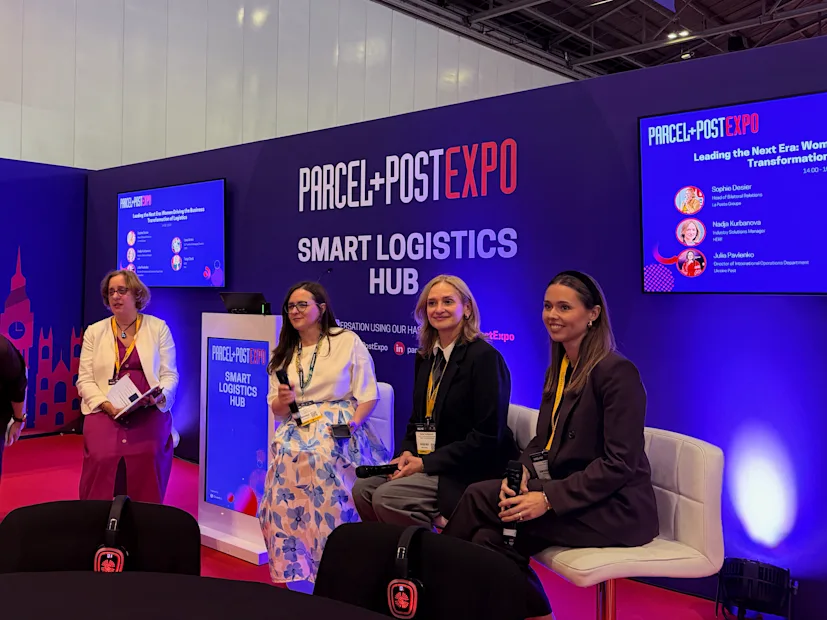
The panel, titled "Leading the next era: women driving the business transformation of logistics," brought together voices from across logistics.
Sophie Desier, Head of Bilateral Relations at La Poste Groupe, moderated the discussion. She was joined by Nadja Kurbanova, Industry Solutions Manager at HERE Technologies, Julia Pavlenko, Director of International Operations at Ukraine Post, Lara Amini, Co-founder and Managing Director of autonomous urban delivery company LOXO, and Tanja Dysli, Chief Operating Officer at TVH, a leading global parts and accessories specialist.
Each panelist brought a different vantage point to the conversation, from postal networks and automation startups to global spare parts supply chains. What tied their perspectives together was a shared interest in what it takes for women to lead in an industry historically defined by trucks, warehouses and tight margins.
Dysli opened the discussion by reflecting on how far the industry has come. "I have worked 25 years now in supply chain and I've never seen more women on stage than today," she said. She added that visibility functions as a form of permission: when women see other women leading, it becomes easier to imagine themselves doing the same.
HERE's own support networks, Kurbanova said, reflect the same point. The company runs a Women Initiative Network (WIN) and takes part in the global Women+ in Geospatial community, both of which offer mentoring on leadership and technical skills, a real need in a field still short on engineers. What makes these communities valuable is networking, mentoring opportunities and visibility. She would rather see such networks open to everyone, not just women, since broader participation tends to produce better outcomes for the whole organization.

Kurbanova expressed confidence that the gender pay gap would narrow given new EU initiatives.
Pay equity emerged as one of the sharper points of debate. Kurbanova pointed to current conditions in Germany, where she said a 17 percent gender pay gap still exists. She expressed confidence that the gap would narrow given new EU initiatives, including board-level representation requirements and remuneration transparency rules already taking effect.
Amini offered a different take from her experience running LOXO, a Swiss automation startup. She said her company remains small and mostly staffed by engineers, a field where women remain hard to find. Rather than tracking pay by gender, she said LOXO pays for the role itself. "We pay for the roles and not the gender," she said.
Pavlenko shared a personal account of breaking into a male-dominated corner of the business. She recalled that when she first joined Ukraine Post around ten years ago, leadership initially hired a man for the director of international operations role, with Pavlenko supporting in marketing and sales. She said the arrangement lasted only ten months before leadership moved on from the hire, citing a lack of flexibility and energy. Pavlenko was then asked to step into the role herself, a position she has now held for a decade.
Pavlenko also addressed the demands of the job outside office hours. She keeps a notebook by her bed for ideas that surface at night, and said time is the main challenge. Balancing that workload with raising a young child, she added, is an ongoing act rather than a problem she expects to solve.
Dysli reflected similarly on parenthood and leadership, crediting her husband's role as a stay-at-home father, a model she said is common in his native Scandinavia, for her ability to lead at her career.

Kurbanova noted that consignees increasingly expect precise delivery timing and the flexibility to reroute at short notice when plans change.
Amini turned the conversation toward the operational pressures facing logistics. She described the work as labor intensive, compounded by a shortage of drivers across Europe and growing resistance from cities toward large delivery vans. LOXO's response has been to automate delivery vehicles for middle and last-mile routes, a model now running in Switzerland and Germany.
Kurbanova connected this operational strain to the limits of artificial intelligence (AI) without strong underlying data and context behind it. She said HERE has focused on what the company calls HERE Location Reasoning, a layer designed to connect large language models, autonomous agents and map data together, since standard AI models are not trained to reason about geography on their own.
Safety also surfaced as a last-mile concern, particularly for female customers receiving deliveries at home. Dysli recalled conversations from her time at a Swedish furniture retailer, where customer research consistently raised safety alongside cost, speed and sustainability. She said simple measures, like showing a customer a photo of the delivery driver in advance, can make a real difference in how safe someone feels answering the door.
The data quality debate revealed a clear contrast. Amini argued that AI has real physical limits once it leaves the screen for the street: her vehicles can't rely on it alone, since no current model can account for everything a city throws at an autonomous van.
For Kurbanova, AI is often overestimated and underestimated at once. A capable model is useless if the underlying data is fragmented or unreliable, she said, but once it's grounded in trusted, accurate, timely data, its output moves from insight toward genuine autonomous decision-making, which is where the real value begins.
Kurbanova also noted a shift in what consignees expect from delivery: precise control over timing and the ability to reroute at short notice. She tied this to the demands of multitasking, such as a parent redirecting a parcel because a child falls sick at school or a meeting runs over. That flexibility, she said, now matters as much to customers as speed or cost.
Across the panel, one idea kept surfacing: progress in logistics depends on people who build networks, mentor newcomers and make room for new voices.
As more women move into leadership across parcel and postal services, startups and technology providers, the message from London was clear: the industry's next era will be shaped as much by mentorship and visibility as by automation.
The panel, held in London and moderated by Sophie Desier of La Poste Groupe, focused on women driving business transformation in logistics, covering topics including salary equity, workplace bias, artificial intelligence and logistics.
The panel featured Nadja Kurbanova of HERE Technologies, Julia Pavlenko of Ukraine Post, Lara Amini of LOXO and Tanja Dysli of TVH, moderated by Sophie Desier of La Poste Groupe.
According to Kurbanova, a 17% gender pay gap persists in Germany, though she pointed to European Union transparency legislation as a sign the gap will continue narrowing.
Kurbanova described HERE's location reasoning capability, which is designed to enhance AI systems by providing a dedicated spatial execution layer that allows AI agents to make accurate, consistent and actionable decisions in real-world environments.
Panelists pointed to mentorship networks, such as HERE Technologies' Women Initiative Network (WIN) and the global Women+ in Geospatial community, as practical ways companies can build visibility and support for women pursuing leadership roles.

Louis Boroditsky
Managing Editor, HERE360
Share article
Louis Boroditsky — 06 October 2026
Louis Boroditsky — 10 September 2026
Louis Boroditsky — 23 June 2026
Get the latest on location technology, AI innovation and HERE product updates delivered straight to your inbox.
What you'll get:
Expert insights on agentic AI, spatial reasoning and location technology
Early access to HERE product updates, demos and resources
Practical guidance on building location-aware AI that works in the real world