
Connected Driving
EV interest is rising. Now the ownership experience must deliver
Ian Dickson — 21 September 2026
12 min read
22 July 2026
Quick answer: |
|---|
Agentic artificial intelligence (AI) is already reshaping the automotive experience—not just through self-driving features, but through smarter in-cabin systems that anticipate driver needs, enhance safety and personalize every journey. In this interview with Marcin Klecha, VP of Engineering for Automotive Solutions at HERE, we explore how agentic AI works inside modern vehicles, why accurate maps are essential to making it reliable and how software-defined vehicles are bringing these capabilities to a wider range of drivers. |
"I remember having the opportunity to buy Bitcoin years ago—maybe even multiple times," said Marcin Klecha, VP of Engineering for Automotive Solutions at HERE. "I brushed it off. It was similar with drones. I contributed to a few early concepts, but once the technology became widely accessible, they were suddenly everywhere. I think the same will happen with agentic AI in cars. But there’s a mental block—a human resistance to change—that we need to overcome first."
New technology has a habit of creeping into our lives almost unnoticed. Something that feels novel or unfamiliar one day quickly becomes part of our standard routine. Agentic AI in the automotive world is heading in this exact direction. While many people focus strictly on fully self-driving vehicles, a quieter but equally meaningful shift is happening inside the cabin.

Read more: Why LLMs understand language but not space
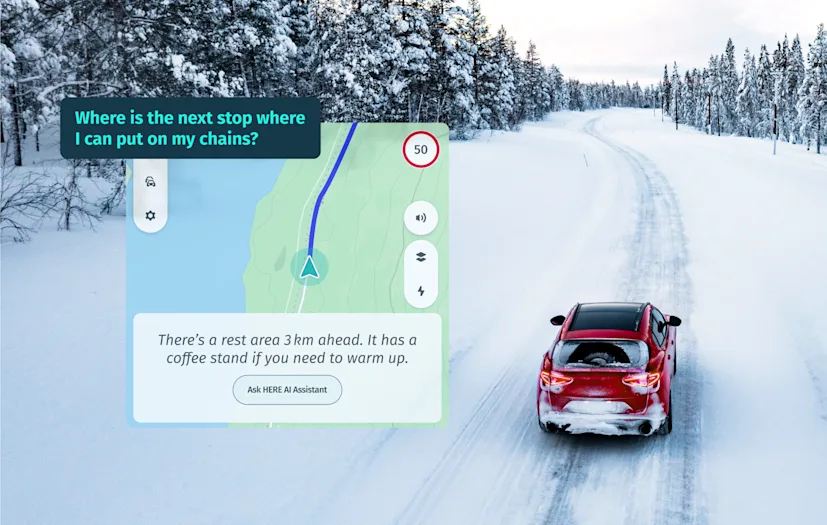
When people think about AI in cars, they often focus on self-driving vehicles, but that’s just part of the story. Agentic AI aims to make using your car easier and more natural. Think of it as a smart in-car assistant that understands you.
These modern systems can plan trips, manage EV charging, adapt to weather changes and work seamlessly with cloud services. If you ask it to change the temperature, switch playlists, or find a charging station, it responds intelligently. This allows automakers to use advanced AI for more complex tasks.The main goal? To reduce stress while driving.
Agentic AI also learns your habits and how you communicate, making your driving experience more personalized. Instead of messing with buttons, you can keep your eyes on the road while the car handles the details. Great examples include personalized trip planning and Navigation on Autopilot (NOA), showing how these systems enhance the driving experience.
“Initial iterations of agentic AI will begin to become more commonplace,” said Klecha. “Their first role will be to make us more aware of the context around us, keeping us alert and ultimately helping us drive more safely.”
Safety is the main driver of automotive innovation. While traditional systems react to problems, agentic AI anticipates issues before they arise. It processes vast amounts of real-time data to help you understand your surroundings before a situation gets critical.
Advanced driver assistance systems (ADAS) and automated features are becoming more common, but they require real-time data for eyes-off, hands-off driving. The more autonomy a vehicle has, the more it needs to adapt to changing traffic and rules. This is where location-aware agents shine. Regulatory pushes, like the EU's Intelligent Speed Assistance (ISA) mandate, alongside growing safety expectations, make these proactive systems crucial.
As a quiet co-pilot, agentic AI monitors changing weather, anticipates traffic and navigates busy streets ahead of time. Instead of overwhelming you with alerts, it filters out the noise, knowing when to speak up and when to stay silent, reducing driver distraction.
“We’re moving away from just entertainment and focusing more on helping people drive safely and stay aware of what’s going on around them,” said Klecha. “I see agentic AI giving us a heads-up: what’s the next move, keeping an eye on the weather and what obstacles might be coming up ahead—so we’re never caught off guard.”

Read more: Enabling spatial reasoning for LLMs
Location is key to maximizing the value of agentic AI in cars. For an AI agent to be truly helpful, it needs a clear and reliable understanding of what's happening outside the vehicle. Even the best AI relies on accurate real-world context.
Location data provides essential details like travel times, turn restrictions and road hazards. For autonomous driving, centimeter-level precision is crucial. Additionally, a dynamic map must include important regulations, speed limits, driving zones, risk hotspots and real-time updates on signage or traffic.
Today’s maps operate as constantly updated, data-rich systems that give AI a detailed picture of the road ahead. HERE’s role in this ecosystem is to keep the location "ground truth" accurate, live and entirely machine-consumable. As vehicles start communicating with each other and with city infrastructure through vehicle-to-everything (V2X) technology, traffic can flow like a coordinated system, making journeys predictable and safe.
As Klecha put it, the map isn’t just a nice-to-have layer: “Without the map, the AI isn’t very efficient for automotive use cases, so grounding LLMs (large language models) in map context is absolutely key.”
For years, automotive innovation followed a familiar path: new tech arrived in premium models first, then slowly filtered down to more affordable cars. The shift toward software-defined vehicles (SDVs) is changing that trajectory completely.
Industry projections show the SDV global share of cars reaching 32% by 2030 and climbing to 46% by 2035. SDVs unify previously separated technology stacks. Navigation, ADAS and autonomous functions now share a common data and software foundation.
This architecture creates a natural environment for agentic AI: cars that understand user goals, interpret context and continuously adapt their behavior.
With SDVs, automakers roll out new features and smarter in-car assistants through over-the-air software updates, completely bypassing major hardware changes. In markets like China, the shift is highly visible. Advanced AI and sensor systems already appear in lower-cost vehicles, bringing natural voice interaction, smarter assistance, and proactive safety to everyday drivers.
“Traditionally, new tech starts in higher-end cars and then filters down over time,” said Klecha. “What we’re seeing in China is advanced features appearing in much more affordable vehicles—at the cost level of a luxury model.”
Agentic AI in cars will soon feel as normal as pulling a smartphone from your pocket. In-vehicle agents are rapidly becoming an indispensable part of everyday driving. The main hurdle ahead isn’t the technology itself, but driver trust.
As system reliability grows and vehicles demonstrate a flawless understanding of their environment, cars will increasingly feel like intelligent companions. They will seamlessly plan our trips, monitor our safety and handle our charging needs.
“I think we’ll trust their inference much more over time,” said Klecha. “The real challenge is just how quickly the technology is evolving. It will take time for us to adjust, but it will happen.”
Most of the early action is happening inside the cabin, not on the road surface. Agentic AI is showing up as a smart in-car assistant that understands natural language, learns your habits and handles tasks you would otherwise do manually: adjusting temperature, switching playlists, finding an EV charging station or rerouting around an accident. The system connects to cloud services, processes real-time data and responds to how you communicate, so the experience becomes more personalized over time. The near-term value proposition is straightforward: keep your eyes on the road and let the car manage the details.
Traditional ADAS is largely reactive—it detects a problem and responds to it. Agentic AI shifts the model from reaction to anticipation. Rather than waiting for a situation to become critical, it processes large volumes of real-time data to give drivers a picture of what is coming before it arrives. That means monitoring changing weather, tracking traffic patterns upstream and flagging potential hazards early. Critically, it also filters what it surfaces. Rather than bombarding a driver with constant alerts, the system applies judgment about when to speak and when to stay quiet, which itself reduces distraction. Regulatory pressure is reinforcing this direction—the EU's Intelligent Speed Assistance mandate is one example of a policy environment that makes proactive, location-aware safety systems a compliance requirement, not just a differentiator.
Sensors tell the vehicle what is directly around it in real time, but they cannot supply the broader context the AI needs to make intelligent decisions. Location data adds a layer that sensors cannot: accurate travel times, turn restrictions, speed limits, road hazard history, driving zone regulations and live updates on signage and traffic conditions. For autonomous driving, centimeter-level precision matters, and that precision has to be maintained dynamically as roads change. HERE's specific role in this ecosystem is to keep that location ground truth accurate, live and in a format that machines can consume directly. As vehicle-to-everything (V2X) technology develops—connecting cars to each other and to city infrastructure—that shared map layer becomes the foundation for coordinated, predictable traffic flow.
The software-defined vehicle (SDV) architecture is disrupting that model. Historically, hardware constraints meant expensive components had to recoup their costs in the premium segment before costs dropped enough to reach mainstream buyers. SDVs change the economics because they unify navigation, ADAS and autonomous functions on a shared software and data foundation. New capabilities can then be deployed through over-the-air updates without hardware changes, which dramatically lowers the cost of distributing new features across a fleet. Industry projections put SDV global share at 32% of cars by 2030 and 46% by 2035. The most visible evidence of this shift is already visible in China, where advanced AI features—natural voice interaction, proactive safety and smart assistance — are appearing in vehicles priced at the cost level of a traditional luxury model.
The main barrier is not technical—it is trust. As Klecha puts it, there is "a human resistance to change" that needs to be worked through, and that process takes time regardless of how capable the systems become. Drivers have to accumulate enough reliable, positive experiences with agentic AI before they are willing to hand over more cognitive control to the vehicle. That trust builds as systems demonstrate a consistent, accurate understanding of the environment around them.

Louis Boroditsky
Managing Editor, HERE360
Share article
Ian Dickson — 21 September 2026
Louis Boroditsky — 17 July 2026
Louis Boroditsky — 01 July 2026
Why sign up:
Latest offers and discounts
Tailored content delivered weekly
Exclusive events
One click to unsubscribe