
Supply Chain
Debate worth having: can Europe's parcel lockers ever share one network?
Louis Boroditsky — 01 October 2026
6 min read
19 January 2026
“The future of logistics will be shaped by the integration of location intelligence, artificial intellgence (AI) and automation, driving efficiency, flexibility and sustainability,” said Bart Coppelmans, Senior Director of Product Management at HERE Technologies.
Coppelmans spoke at the Leaders in Logistics Summit in Berlin earlier this year, where industry leaders discussed the challenges and opportunities in the logistics industry.
The discussion comes at a prescient time. From rising operation and labor costs to more stringent sustainability targets, the logistics industry is in a delicate position.
“The next wave of location intelligence innovation will focus on addressing these challenges,” Coppelmans added.
Let’s take a look at some of the key trends expected to shape the logistics sector in 2026.
According to global logistics company DHL, the transportation and logistics sector is responsible for almost a quarter of all carbon dioxide emissions. So perhaps unsurprisingly, it expects sustainability to be a key trend in 2026.
DHL says sustainability isn’t just a “nice-to-have” anymore. Location-powered route optimization and fleet management software can lead to more efficient loads, less wasted time and help fleets choose the right vehicle for the job.
But DHL sees other trends shaping sustainable logistics next year. This includes “carbon footprint tracking”. These new dashboards would allow operators to see their emissions output in real time, helping them reduce their footprint while keeping their business moving.
DHL also believes we’ll see reusable packaging become a thing next year. “Smart tracking systems show when a box or container is ready to be picked up from the customer or a nearby drop-off point, so it can be sent out again—saving money and cutting waste,” it said in a report.
AI and real-time data are supercharging the modern logistics landscape. “AI-driven systems can integrate real-time traffic conditions, road closures and historical delivery performance to dynamically adjust routes," said Coppelmans. "This reduces delays and lowers fuel costs.”
And every delivery provides new data. Companies that capture and analyze driver insights—such as better drop-off locations, restricted access points or peak congestion times—can improve each subsequent delivery.
But AI-powered navigation systems will take a major leap forward next year. HERE AI Assistant, which uses natural language prompts, can provide high-quality and instantaneous results to complex location-related queries.
Combining real-time traffic conditions, road closures and historic delivery performance, the AI-powered navigation system can quickly adapt to changing road conditions and optimize routes based on time or cost constraints to reduce fuel costs and minimize delivery delays.
Integrated into HERE Navigation and HERE SDK, HERE AI Assistant is also available to transportation and logistics companies through the commercial vehicle version of the HERE WeGo Pro mobile application.
"HERE AI Assistant transforms how users interact with vehicle navigation systems," said Denise Doyle, Chief Product Officer, HERE. "This solution delivers personalized, real-time insights, enabling smarter route planning, enhanced safety features and seamless adaptability to changing conditions."
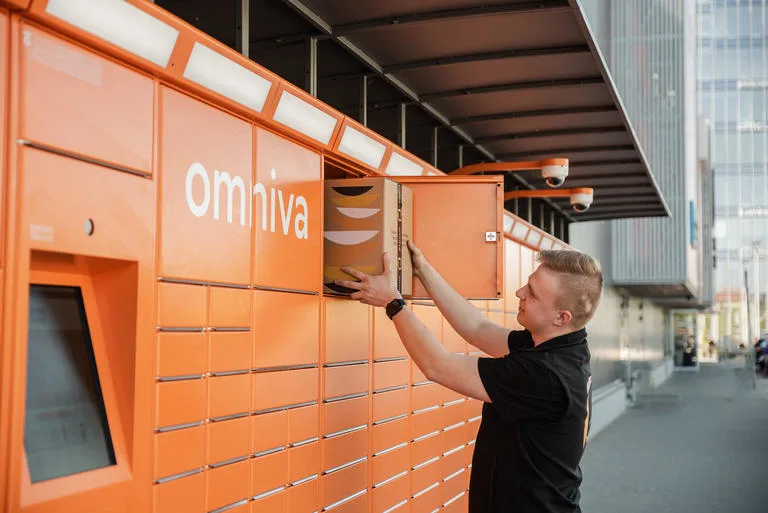
Omniva is now the biggest parcel locker player in the Baltic market with 1240 parcel machines and 1000 daily routes.
Image credit: Omniva
A major challenge in parcel delivery is keeping zones stable and efficient, even when volumes rise or fall. Territory Assignment Optimization (TAO) helps solve this by creating delivery areas that don’t need to be constantly changed. It uses AI to analyze thousands of demand scenarios, so delivery territories stay consistent while keeping costs low.
Omniva, the leading parcel locker provider in the Baltic region, partnered with HERE and Kardinal to implement TAO to enhance its delivery network to meet the growing demands of e-commerce.
The solution helps Omniva optimize its delivery network by analyzing historical data to determine the ideal fleet size and improve route efficiency. Dynamic route planning powered by HERE Matrix Routing API adapts to real-time traffic and changing parcel volumes.
Assigning drivers to consistent territories boosts familiarity and performance, and the system is built to scale as Omniva expands into Central Asia and handles growing eCommerce demand. By optimizing parcel-locker locations and planning smarter routes, the solution also supports stronger cost control and higher overall productivity.
Autonomous robots look set to become a standard fixture in end-to-end logistics, reshaping how goods move from warehouse to door.
This robot is called MobED, a production-ready autonomous mobility robot platform from Hyundai Motor Group that’s scheduled for release in 2026.
MobED uses AI-driven navigation, lidar and cameras to safely map and navigate complex environments. One of its key features is “eccentric posture control”, which dynamically adjusts wheel height and balance, allowing it to traverse uneven terrain, curbs, indoor-outdoor transitions, or narrow pathways that would challenge many traditional delivery robots.
For delivery and logistics providers, this opens up new possibilities for small-package and last-mile delivery in dense urban or mixed indoor-outdoor environments. Its modular design and open APIs allow operators to customize it for diverse use cases, from parcel or food delivery to warehouse logistics.
Robotics giant ABB has also introduced its new AMR P603 robot, which could revolutionize warehouse logistics. Using sensors and location tech, it can navigate autonomously in dynamic industrial spaces without relying on physical guides. ABB says it is 10% faster than average autonomous mobile robots.
“Autonomous vehicles and drones will also play an increasingly prominent role,” added Coppelmans. “Location intelligence will ensure smooth operation, providing real-time data for navigation in complex urban environments.”

Ian Dickson
Contributor
Share article
Louis Boroditsky — 01 October 2026
Louis Boroditsky — 24 August 2026
Louis Boroditsky — 04 August 2026
Why sign up:
Latest offers and discounts
Tailored content delivered weekly
Exclusive events
One click to unsubscribe