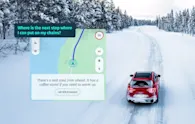
Connected Driving
EV interest is rising. Now the ownership experience must deliver
Ian Dickson — 21 September 2026
6 min read
19 February 2026
When the first cars rolled out, no one imagined vehicles that could make decisions, predict the weather or navigate traffic. Yet today, most of these advances are rapidly becoming our reality.
In 2026, the digital cockpit is set to turn driving from simple transportation into a connected, intuitive experience, where your car anticipates your needs and stays in sync with the world around you.
This is mobility being redefined, one smart car at a time—and we’re unpacking what that means for drivers.
For decades, car dashboards did one simple job: show speed, fuel and warning lights—just enough to tell drivers when to slow down, fill up or see a mechanic.
Modern dashboards look completely different.
Thanks to artificial intelligence (AI) and advanced location technology, stepping inside a car and driving off in 2026 feels less like operating a piece of machinery and more like being driven by a seasoned local.
Imagine a system that knows your daily commute, suggests the best route to avoid unexpected construction and even locates a parking spot before you realize you need one. It anticipates potential hazards, roadblocks and inconveniences to save you time and minimize stress.
To do this, modern cockpits integrate AI and machine learning to continuously adapt.
And it’s not a static tool either, as it learns about your habits and preferences. For instance, if you prefer scenic routes over highways on weekends, this is a piece of information it will remember. Or if you crank up the heating regularly, it learns to adjust the climate control before you ask.
This level of customization also helps reduce distractions, allowing the car to handle all the details and the driver to focus on the drive itself.
It’s amazing how vehicles have evolved to make accurate decisions on their own, but to do that, they rely on processing huge amounts of real-time data. This includes everything from weather updates and traffic congestion to the battery status of an electric vehicle.
From predictive navigation to personalized comfort and enhanced safety, it's the constant exchange of information that makes it all possible.
And in the context of autonomous or semi-autonomous driving, the car's ability to continuously communicate with other vehicles and infrastructure is a matter of safety.
The digital cockpit serves as the central hub for all this information. It translates complex data from the car's sensors and network into a simple, easy-to-understand interface for the driver. For example, it visualizes potential safety hazards by showing you what the car "sees", like an obstacle, a sudden traffic jam or a change in the road surface.
This clear communication helps build trust between the driver and the vehicle.
In fact, these cars run on code as much as they run on electricity or fuel, shaping a future where software-defined vehicles are the norm.
If we think of the data as the fuel, location technology is the engine that drives these smart systems.
Advanced location intelligence transforms the cockpit from a passive display into a proactive safety tool, ensuring that every decision the car makes is based on the most accurate, up-to-the-second reality of the physical world.
Services like HERE HD Live Map provide highly detailed, real-time mapping information, giving vehicles a level of environmental awareness that human eyes simply cannot match. This continuous stream of updated data ensures vehicles can make safe and efficient decisions, even in complex or rapidly changing environments.
Combining this level of accuracy with traffic focused services such as the HERE Real-Time Traffic, enables the car to "see around corners", warning the driver of icy patches miles ahead or rerouting the car to avoid a traffic jam that just started forming.
This same real-time data powers the HERE Intelligent Speed Assistance (ISA) solution, which delivers accurate, up-to-date speed limit information. It also includes changes in dynamic speed limits to help drivers maintain the correct speed and reduce the risk of speeding violations.
This technology turns these live updates into smoother commutes, keeping you safe while shaving minutes off your drive.
No car is truly connected without precise knowledge of where it is and what surrounds it. And this goes far beyond basic coordinates, covering everything from the curvature of the road to the exact placement of lane markings and dynamic speed limits.
2026 is promising to deliver cars that are fully integrated with our specific preferences, habits and needs.
The digital cockpit will become a central hub where you can manage your schedule, join a conference call and even control smart home devices, all while moving.
This connectivity turns travel time, which is usually considered wasted, into an opportunity for productivity or relaxation.
It also enhances safety through context-aware suggestions. For instance, voice assistants using location data might suggest stopping for a charge at a station that also has a coffee shop you like, just when your energy and the car's battery is running low.
We are moving toward a future where cars are becoming intelligent partners that actively look out for us.
As vehicles continue to take on more responsibility, whether through autonomous features or advanced driver-assistance systems, it's crucial for drivers to feel confident in the technology.
This evolution is guided by stringent regulations and industry standards, ensuring that advancements in the digital cockpit prioritize safety, efficiency and convenience for drivers.

Maja Stefanovic
Senior Writer
Share article
Ian Dickson — 21 September 2026
Louis Boroditsky — 22 July 2026
Louis Boroditsky — 17 July 2026
Why sign up:
Latest offers and discounts
Tailored content delivered weekly
Exclusive events
One click to unsubscribe