
Connected Driving
EV interest is rising. Now the ownership experience must deliver
Ian Dickson — 21 September 2026
7 min read
15 January 2026

“If you don’t know where you are in the SDV journey, it’s hard to define your strategy,” said Maite Bezerra, Senior Principal Analyst at Omdia. “This framework gives the industry a common language.”
Moving to software-defined vehicles isn’t something that happens with a flip of a switch—it’s a gradual, step-by-step transition. To help automakers understand where they stand and what comes next, HERE Technologies and Omdia have mapped out a four-phase maturity framework. It gives teams a simple way to gauge their progress, see how they compare with the rest of the industry and plan their next move with clarity and confidence.
Before you can shape a smart SDV strategy, you need a clear view of the full trajectory. The HERE-Omdia framework breaks it into four stages: connected, augmented, adaptive and agentic. Each phase has its own mindset, tech needs and business opportunities.
In the initial phase, vehicles are essentially connected devices. They can receive over-the-air (OTA) updates, but those updates don’t fundamentally change what the car can do. The experience stays more or less the same as the day it rolled out of the factory.
At this point, the automaker is still operating like a classic hardware company: the car might have internet access for things like connected navigation, but its core capabilities are locked in for life.
The sophomore phase is where cars start feeling truly software-driven. Suddenly, your vehicle can pick up new tricks after you drive it away from the dealership, such as smarter infotainment, upgraded navigation with live traffic or more natural voice commands.
The automaker moves beyond pure hardware and starts to behave more like a software conductor, setting the rules for suppliers and making sure new digital features work together. The experience is definitely richer, but most updates still stick to the “fun extras” rather than the core driving systems.
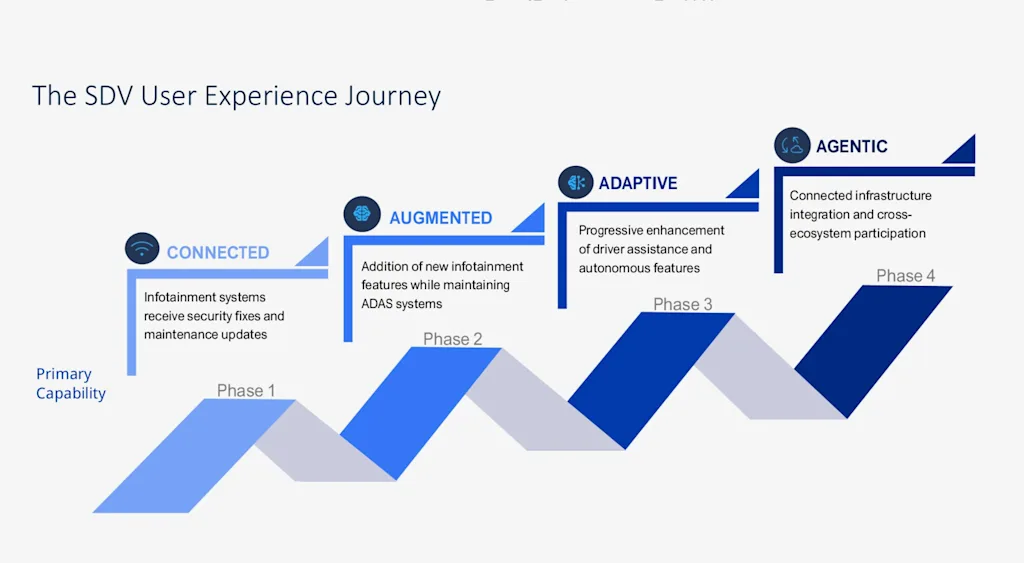
This phase-by-phase model provides automotive companies with essential planning tools and strategic foresight, enabling them to develop effective roadmaps, allocate resources strategically and create sustainable competitive advantages.
This is where the vehicle truly starts to become intelligent. In the adaptive phase, an advanced electrical and electronic (E/E) system brings the car’s various systems into even closer coordination.
With edge AI, the car can learn from you, understand the situation and adjust to your needs. Maybe it notices you’re heading to the airport and fires up navigation automatically, or it senses you’re tired and suggests turning on an autonomous driving feature.
Getting here takes a major shift in how the automaker works. They have to think like a software company, with expertise in AI, data analytics and cloud computing. The vehicle becomes a dynamic, customizable platform, capable of adding new performance upgrades and autonomous features over its lifetime.
The final phase is where the software-defined vehicle reaches its ultimate potential; a world where you car is essentially a shell housing an intelligent agent that ties your entire digital life together. The vehicle becomes just one piece of a bigger, connected ecosystem.
This smart agent doesn’t wait for instructions; it anticipates what you need. Feeling stressed and rushing to catch a flight? It might book fast-track security and lounge access before you even ask. Achieving this level of service relies on tight integration with the Internet of Things (IoT) and smart city infrastructure. To make it happen, automakers shift into mobility tech companies, creating value through cross-industry partnerships and data-driven services that go far beyond the car itself.
Knowing where your organization sits on the SDV Maturity Framework is key to setting achievable goals.
Greenfield OEMs and new market entrants, especially in places like China, can often skip the early stage and launch vehicles at Phase 2 or Phase 3. Without legacy systems holding them back, they can hit the ground running.
Most established automakers start at Phase 1. For them, the challenge is not just technology but culture. Making the leap means shifting from a hardware-first B2B approach to a customer-focused B2C mindset.
To figure out where you stand, ask yourself: |
|---|
Organizational readiness: are you a hardware manufacturer, a software integrator or a full-fledged software company? |
Enabling technologies: can your E/E architecture do more than firmware updates? Are cross-domain functions possible? |
Customer experience: is the in-car experience fixed or evolving? Can you roll out new features after the vehicle leaves the dealership? |
Progress comes step by step. Problems left unsolved early on only get bigger later. Each phase builds on the one before, so skipping steps is a recipe for frustration.
Align expectations with capabilities. A Phase 2 automaker will struggle to implement the monetization strategies of Phase 3. Technology and business model need to evolve together.
A clear vision and smart investment set the pace. Start by mapping the current position, defining where the company wants to go, and pinpointing goals for the next vehicle model.
Reaching Phase 4 is not the target for every OEM, but understanding the possibilities allows for a focused, achievable path forward.
Partnerships can make a huge difference. Experts with experience across the SDV journey can help you avoid common pitfalls. A unified location data platform, for example, provides the consistent context that makes devices smarter and the user experience more reliable from day one.
Automakers that thrive won’t just react to change—they will design it. They will make deliberate choices about where to push technology, where to partner and how to turn data into real value for customers. Success belongs to those who treat the SDV journey as a strategic play, not just a technical challenge.

Louis Boroditsky
Managing Editor, HERE360
Share article
Ian Dickson — 21 September 2026
Louis Boroditsky — 22 July 2026
Louis Boroditsky — 17 July 2026
Why sign up:
Latest offers and discounts
Tailored content delivered weekly
Exclusive events
One click to unsubscribe