
Trends
Summer of sport: disruption for drivers in Paris
Ian Dickson — 13 August 2024
7 min read
19 December 2025
America’s pro football league is the most-watched sports competition in the United States, drawing millions of fans on each game day. As the 2025 season comes to an end, HERE Technologies analyzed traffic patterns around all 30 major stadiums to identify which venues experience the most severe game day congestion—making it harder for fans to get to the game.
The analysis consists of two components, both focused on a one-mile radius around each stadium:
A final list from 1 to 30, where #30 (stadium with the highest total score) represents the worst stadium for game day traffic (highest impact on local roads) and #1 (stadium with the lowest total change score) represents the best (lowest impact on local roads). Sample period: September 4 to November 2, 2025 from 9am-9pm local time on those days.
Real-time congestion insights, providing live traffic conditions as well as week-over-week comparisons. This allows you to check traffic around you favorite team’s stadium at any time and see how current conditions compare to the previous week.
Our traffic data is derived from HERE Real-Time Traffic, which lets drivers predict traffic delays and calculate routes with more safety and accuracy. For details about rankings methodology and metrics, check the bottom of this page.
This analysis provides an overview of how each stadium ranked on a game day during the sample period, shown both on a map and in a table using the same ranking.
Hovering over the map reveals a pop-up with a detailed view of how speed and traffic congestion change on game days compared with non-game days for each stadium. Scrolling through the pop-up also shows how congestion looks right now compared with one week ago.
In the table, you’ll see all stadiums ranked by their final game day score, along with the two metrics that contribute to that score: congestion change and speed change.
Key insights:
At the top end of the spectrum sit the Atlanta Falcons at Mercedes-Benz Stadium. Game-day congestion increase is at only 12% over non-game days while absolute congestion levels remained below 2 — meaning traffic stayed largely free-flowing. Combined with only a small drop in speeds (-2.83%), this earned the stadium the top spot in our ranking. Interestingly, the stadium sits in downtown Atlanta, and the overall urban context is dense. Traffic conditions are influenced not only by game-day arrivals but also by ongoing commuter traffic, tourism, and downtown activity.
Highmark Stadium, home to the Buffalo Bills, saw significantly more congestion on game days than any other stadium, over 580%. At the same time, average speed was almost 25% slower. This makes the stadium rank last overall. Highmark Stadium sits in an outer-ring suburb of the Buffalo metropolitan area with a relatively low population density. Its location means that game-day traffic impacts are driven more by incoming vehicles from a broad regional area than by high local resident density immediately adjacent to the venue.
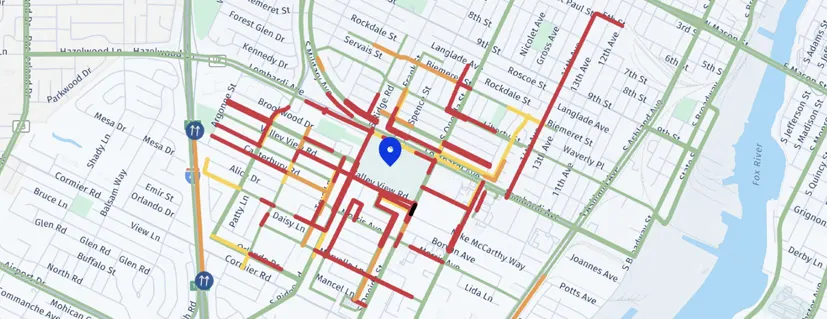
Below sliders capture traffic snapshots from the sample period for the five lowest-ranked stadiums. Moving the slider allows you to compare game-day and non-game-day congestion. Green indicates free traffic flow, orange minor traffic disrutions, and red increasingly heavy and slow traffic:
Rank #30: Highmark Stadium, Orchard Park, New York
Rank #29: Gillette Stadium, Foxborough, Massachusetts
Rank #28: Raymond James Stadium, Tampa, Florida
Rank #27: Hard Rock Stadium, Miami Gardens, Florida
Rank #26: Lambeau Field, Green Bay, Wisconsin
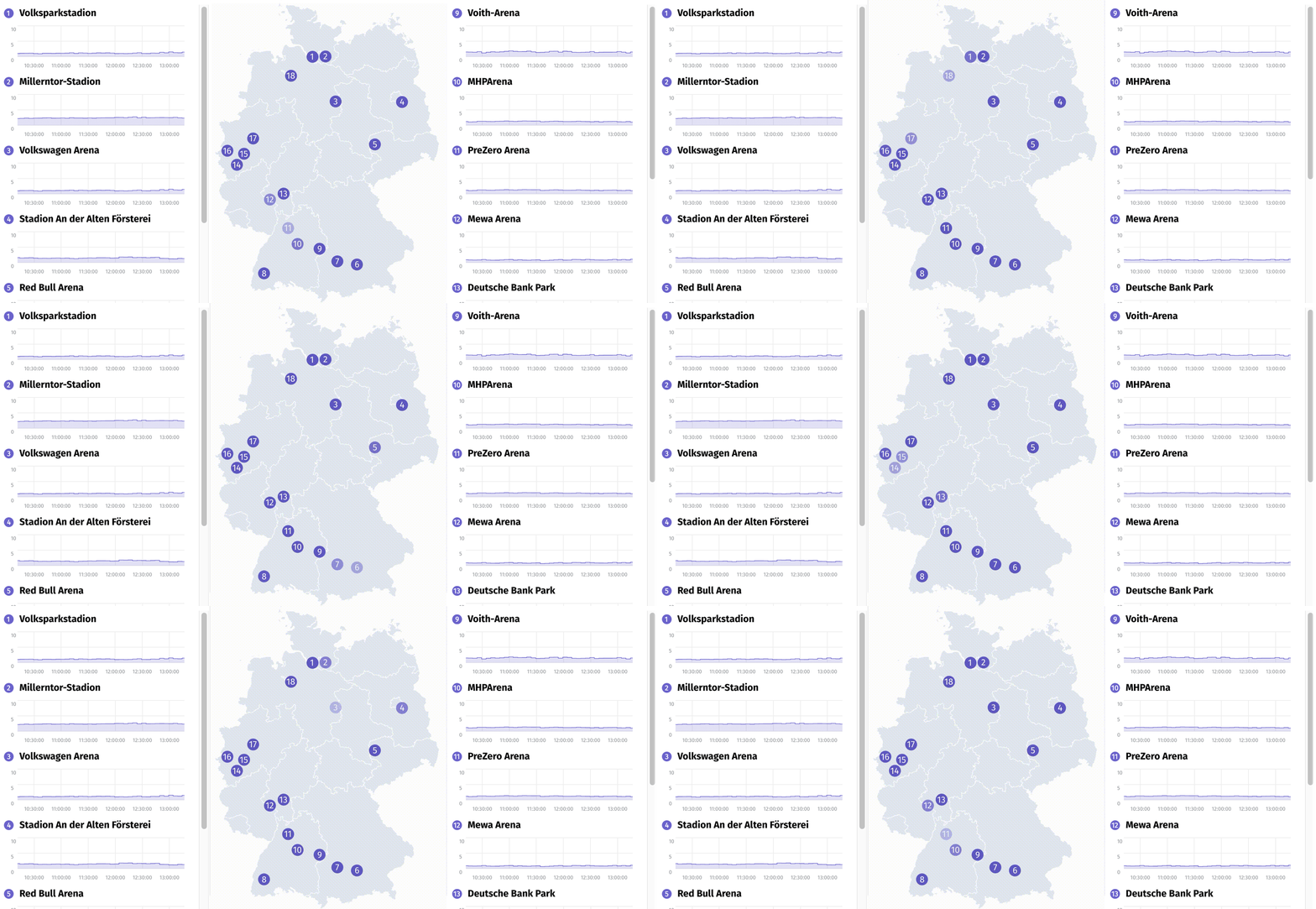
This dashboard shows all 30 stadiums labeled according to the ranking above so you can find them more easily—but this time highlighting what is happening right now on the ground at each location. The line graph shows the week-over-week percentage change. Clicking on it reveals absolute congestion levels and additional details.
Our dashboard updates every five minutes, 24 hours a day. Check back regularly to see how congestion evolves throughout the season, and beyond!
Interested in more traffic analytics? Check our stories about German soccer stadium traffic, our Paris Olympics venues traffic analysis and the European soccer tournament stadium traffic analysis.
———
Metrics used:
Speed: average traffic speed in MPH
Congestion (also called congestion score or jam factor): a value between 0 and 10 representing the density of traffic, with 0 being the least congested and 10 being the most congested
Percent congested: percent of roadways showing congestion (defined as JamFactor>=4, the equivalent of yellow/red visualized on our map)
Sample period: September 4 to November 2. These two specific timeframes were compared to isolate the net impact of the event itself, effectively measuring how much worse traffic gets simply because a game is happening.
Radius: 1 mile around each stadium
Game day ranking methodology:
Each stadium was ranked based on the change in conditions caused by the game.
Calculating the delta: for every stadium, the difference between a regular Sunday and a game day Sunday was calculated for all three metrics (e.g., how much speed dropped, how much congestion intensity spiked, and how much congestion spread).
Individual metric ranking: the 30 stadiums were ranked from 1 to 30 for each individual metric, where a rank of 30 represented the largest change (e.g., the biggest drop in speed), and 1 represented the least.
Game day rank: the rankings of all three metrics were combined to create a total change score. The stadiums were then re-ranked based on this final score to produce the game day rank.

HERE Technologies
Share article
Why sign up:
Latest offers and discounts
Tailored content delivered weekly
Exclusive events
One click to unsubscribe