
Connected Driving
EV interest is rising. Now the ownership experience must deliver
Ian Dickson — 21 September 2026
7 min read
19 December 2025
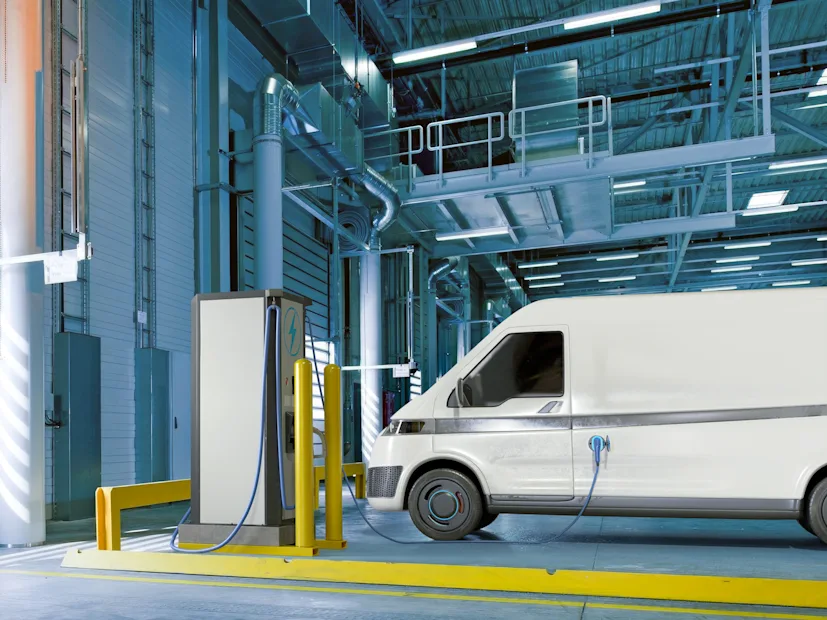
If you asked a fleet manager in 2020 about the biggest challenge facing their industry, they might have listed factors such as high fuel costs or driver shortages.
Ask them today, and the answer you'd get is very different.
From range anxiety to route optimization, fleet managers are currently facing a whole new set of challenges to meet the demands of modern logistics.
Overall, 2025 proved to be a pivotal year for electric vehicle (EV) adoption in commercial fleets, showing that the transition is no longer a question of "if" but "how fast," redefining the concept of sustainable logistics and its future.
For years, the fear of running out of charge mid-route was the main barrier to widespread EV adoption in logistics.
Both drivers and managers worried that battery limitations would leave trucks stranded and deliveries late. But 2025 showed us that range anxiety is a solvable data problem, not a permanent hardware limitation.
As battery technology improved, we saw ranges extend significantly, but the real breakthrough came from better predictability. Fleet operators discovered that by using advanced location data, they could predict energy consumption with high accuracy before a truck even left the depot. Factors such as topography, weather, traffic patterns and cargo weight were no longer surprises but inputs for precise planning.
And the shift from guessing to knowing is what made all the difference.
Drivers now trust their dashboard estimates because they are backed by precise data, allowing them to push their vehicles further and use their full capacity.
Building charging infrastructure used to be a simple construction project: dig a trench, lay a cable, install a charger. This year taught us that it is actually a complex optimization puzzle that requires a data-first mindset.
In fact, the most successful deployments in 2025 were those that used location intelligence to analyze grid capacity, route patterns and dwell times simultaneously.
This is because a charger can't just be placed wherever a truck parks. It needs to be installed where the truck stops for the right amount of time and where the electric grid can handle the power without huge extra costs.
Infrastructure developers started using tools to model their entire network, simulating thousands of trips to identify the optimal locations for fast chargers versus overnight depots. This strategic approach prevented costly retrofits and ensured that infrastructure investment delivered a significant return on investment.
Another important finding was that physical hardware is useless without digital intelligence to place it correctly, turning location technology into the backbone of EV efficiency.
An electric truck is only as good as the software running it, or, in other words, the location technology guiding it.
What this means is that an electric fleet can't be managed effectively with the same tools used for diesel trucks.
For instance, EV routing and charging solutions allow managers to optimize routes not just for time or distance, but for battery health and energy consumption. Incorporating detailed map data including road curvature and elevation could save significant amounts of energy by avoiding routes that drain batteries unnecessarily.
Solutions such as HERE EV Charge Points give drivers real-time information on charger availability and compatibility, eliminating the frustration of arriving at a broken or occupied station.
This integration of location tech into the daily workflow proved that efficiency in an electric fleet is not achieved by driving slower, but by driving smarter.
Electric vehicles have fewer moving parts than internal combustion ones, which should, in theory at least, mean less maintenance. But 2025 taught us that less maintenance still is maintenance, and a very specific kind of maintenance.
Scheduled oil changes and belt replacements might have become a thing of the past, but the switch to EVs also introduces a whole new set of components that need upkeeping, such as predictive battery health management.
Fleet managers learned that the way a vehicle is driven and charged has a direct impact on the long-term viability of its most expensive component, the battery.
By analyzing data on charging cycles, depth of discharge and temperature exposure, operators could predict when a battery module needed attention before it failed.
This shift required a new set of skills and tools, turning mechanics into data analysts. The industry witnessed a rise in software platforms that monitor vehicle health in real-time, flagging irregularities that a human driver might miss.
This proactive approach drastically reduced downtime, as issues were addressed during scheduled stops instead of on the side of the highway.
Another thing 2025 reminded us is that the human driver is still the heart of the fleet.
We learned that drivers who were properly trained on regenerative braking techniques and energy-efficient driving habits could extend the range of a vehicle by a significant margin compared to untrained peers.
Gamification and real-time feedback became powerful tools for encouraging these behaviors, turning efficiency into a competitive sport.
But beyond efficiency, we saw that drivers actually preferred the electric experience once they adapted to it. The reduction in noise and vibration led to less fatigue and higher job satisfaction, which is a crucial factor in an industry that deals with one of the highest turnovers.
Successful fleets were those leveraged the fact that technology works best when it works together with people, not when it attempts to replace them, proving that the future of logistics is human-centric, even as it becomes increasingly automated.
As 2025 slowly comes to an end, it's clear that prioritizing driver well-being and integrating new technologies leads to better efficiency and sustainability in the logistics sector.
As the logistics industry evolves, probably the biggest takeaway for electric fleet managers is that a human-centered approach paves the way for a more resilient future.

Maja Stefanovic
Senior Writer
Share article
Ian Dickson — 21 September 2026
Louis Boroditsky — 22 July 2026
Louis Boroditsky — 17 July 2026
Why sign up:
Latest offers and discounts
Tailored content delivered weekly
Exclusive events
One click to unsubscribe