
APIs
Benchmarking how LLMs use location tools
Piyush Pelagade — 14 October 2026
3 min read
26 August 2026
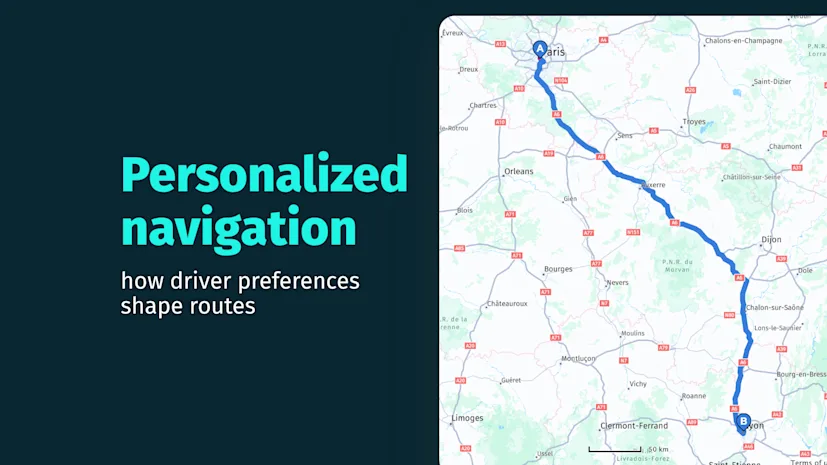
It is often assumed that there's one best route from point A to point B, but that's rarely the case.
In modern navigation, the same origin and destination can produce completely different routes depending on traffic conditions and the routing preferences applied during route calculation.
That's because routing isn't driven by map data alone. It can also be shaped by configuration.
Let's start with a simple route calculation. Given an origin and destination—in the case below, between Paris and Lyon, France—the routing engine calculates a route based on its default settings:

An example of a simple route calculated on default settings.
What happens when a driver doesn't want to use toll roads?
By applying an "avoid toll roads" preference, the routing engine recalculates the route using a different set of rules.
The destination and road network stay the same, while only the routing configuration changes:

A route calculated with toll roads avoided.
Notice how the route changes. This is one of the core ideas behind personalized navigation: the best route isn't determined solely by your destination, it's influenced also by how you want to get there.
Within the HERE SDK, routing behavior can be customized through RouteOptions. Using HERE Routing API, similar behavior is controlled through request parameters.
These options allow developers to tailor routes for different needs, such as:
Avoiding toll roads
Selecting vehicle types
Applying EV-specific routing settings
Considering traffic conditions
Rather than generating a one-size-fits-all route, you can configure routing to account for a user's specific needs and preferences.

A side-by-side comparison of a default route and a route that avoids toll roads.
Personalization becomes even more important when vehicle requirements differ. For example, car routing can incorporate traffic conditions when calculating a route.
Electric vehicle routing can also include charging stops and energy consumption calculations when EV-specific parameters are provided.

An example of an EV route that incorporates charging considerations, with charging stations shown along the journey.
These aren't UI-level adjustments. They're part of the route calculation itself.
Whether you're building a navigation app, delivery platform or fleet solution, routing preferences directly influence the experience you deliver.
Small configuration changes can lead to significantly different outcomes. That's why route calculation should never be treated as a one-size-fits-all problem. The best route isn't always the same route—it's the one that best matches the driver's needs.
Take a look at calculating the same route with different routing preferences. Avoid toll roads. Enable traffic-aware routing. Switch to EV routing.
You'll quickly see that the same journey can produce very different results depending on the configuration you provide, because modern navigation isn't just about calculating routes.
It's about personalizing them.

Bhavin Pun
Developer Advocate
Share article
Bhavin Pun
Developer Advocate
Why sign up:
Latest offers and discounts
Tailored content delivered weekly
Exclusive events
One click to unsubscribe