Insights & Trends
What to watch at the Paris Motor Show: insights from HERE's CCO
Louis Boroditsky — 09 October 2026
4 min read
20 May 2026
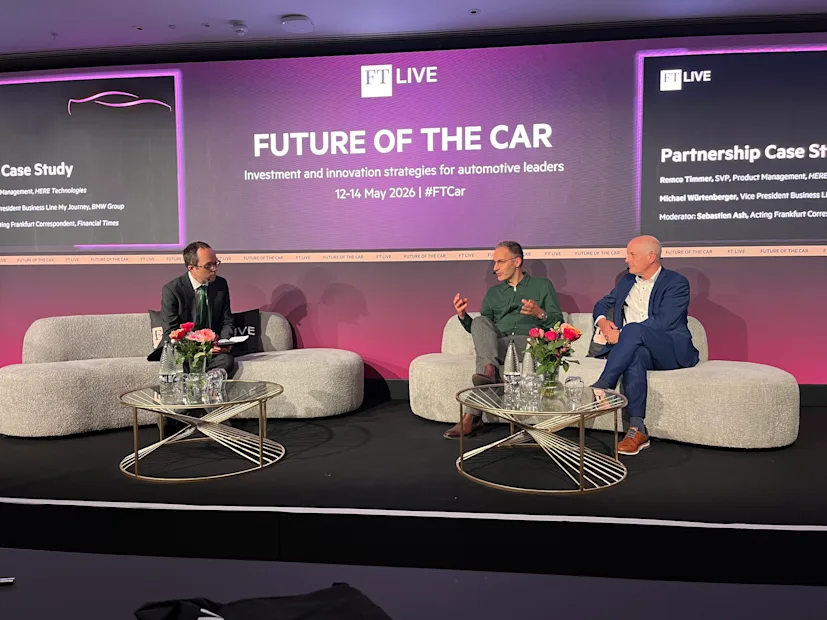
The summit convened senior leaders across the automotive ecosystem to explore the technologies, partnerships and business models shaping next-generation vehicles.
For HERE, it was an opportunity to highlight its leadership in mapping, location intelligence, AI-driven navigation and in-vehicle experiences.
A key moment was the HERE fireside chat, moderated by the Financial Times’ Sebastien Ash, featuring Remco Timmer, SVP Product Management at HERE, and Michael Würtenberger, VP Business Line My Journey at BMW Group.
The discussion focused on how mapping has evolved into a foundational platform for the software-defined vehicle.
“Mapping is a central element,” said Würtenberger. “If you are mobile, and the car is still a mobile device, (…) mapping is the base platform for many things later on, from ADAS to information.”
As vehicles become more advanced, the complexity and importance of map data continue to grow—particularly for ADAS, automated driving and digital in-car experiences.
Timmer highlighted how vehicle data is enabling more dynamic and continuously updated maps. As vehicles are becoming increasingly capable, that gives HERE an incredible opportunity to use data from its automotive partners’ cars to create the most up-to-date, comprehensive and continuously refreshed maps possible.
The conversation also touched on the accelerating rollout of assisted and automated driving features across global markets. Timmer remarked that there is a clear ambition to expand these features and make them a seamless part of the driving experience.

“The critical thing is to ground it in facts, and here is where the map interface is critical. You don’t want the model to hallucinate a route to a destination that doesn’t exist,” — Remco Timmer, SVP Product Management at HERE Technologies, on voice commands in the car.
Photo credit: FT:LIVE
Regional variation remains a critical factor in deploying mobility solutions at scale.
“People are different, customers are different, societies are different and infrastructure varies as well,” said Würtenberger. “A one-size-fits-all solution simply doesn’t work.”
HERE enables localization through flexible, software-driven approaches, including the integration of local services into global platforms, helping automakers scale while staying relevant in each market.
AI is playing an increasingly important role across both map development and the in-car experience. It has long been part of the technology stack, but its impact is accelerating. It’s also shifting the user experience toward more conversational interactions.
Timmer emphasized the importance of reliability and grounding AI in real-world data. About voice commands in the car, he remarked: “The critical thing is to ground it in facts, and here is where the map interface is critical. You don’t want the model to hallucinate a route to a destination that doesn’t exist.”
For BMW, mapping is a key differentiator—particularly for EV routing, where accurate data helps reduce range anxiety and improve the driving experience.
Würtenberger also pointed to the need to balance frequent software updates with usability, while Timmer highlighted HERE’s more iterative approach to innovation.
HERE’s presence at the summit reflected the strength of the company’s role in the mobility ecosystem: helping automakers and technology partners connect navigation, maps, AI and assisted driving into integrated experiences that are ready for the future of movement.
Main image credit: Sebastian Kurme

HERE Technologies
Share article
Louis Boroditsky — 09 October 2026
Tomi Agócs — 02 October 2026
Menghan Cui — 22 September 2026
Why sign up:
Latest offers and discounts
Tailored content delivered weekly
Exclusive events
One click to unsubscribe