
Map content & data
HERE GIS Data Suite: Foundational Location Data for ArcGIS Pro
Mohini Todkari — 29 July 2025
7 min read
28 April 2026
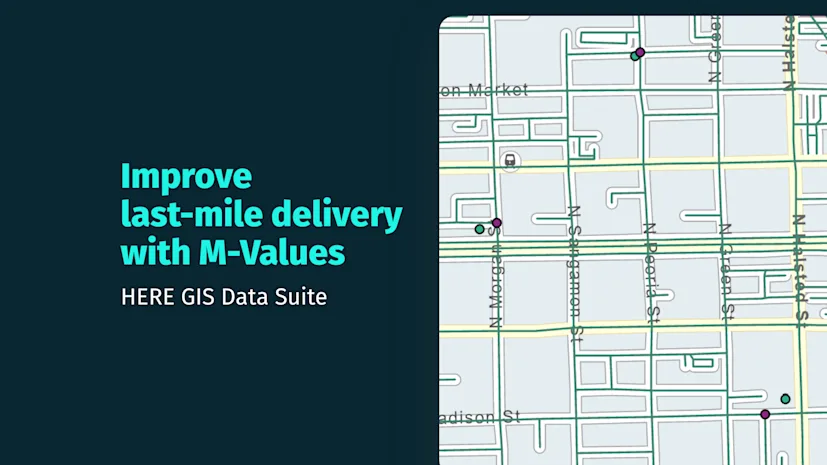
In last mile delivery, the final stretch of a route spans from a distribution hub to the customer’s door. This is where cost, time, and service quality are won or lost.
Many last‑mile workflows rely on x, y coordinates alone to represent delivery stops. While coordinates describe where something is in space, they often fail to describe where along the road network a stop occurs. This becomes a problem when multiple stops share the same road segment. Access points differ from mailing addresses, or when planners need to analyze performance at the level of individual road links.
M‑values help address this gap.
An M‑value is a measure of position along a linear feature – specifically how far along a road segment a given location is, expressed as a numeric distance from a defined starting point.
In standard GIS, every point on a map is described by x and y coordinates, which are longitude and latitude. That tells you where something is in space. But for many real-world applications, knowing where along a road something occurs matters just as much.
An M‑value adds that third dimension of meaning: distance along the network.
For example, instead of describing an incident occurring at coordinates -87.6534, 41.8827, you can describe it as occurring 347 meters along Link ID 112458903. This description is meaningful to anyone managing that road segment, regardless of map projection or coordinate system.
This concept is called Linear Referencing, and it is the foundation of how transportation agencies, logistics operators, and infrastructure managers describe locations along roads and other linear networks in a way that is operationally meaningful rather than just spatially precise.
In last‑mile logistics, M‑values unlock capabilities that are difficult or impossible to achieve using x, y coordinates alone.
Many delivery addresses share the same road link, which could be a long city block containing dozens of stops on a single HERE link.
M-values provide a network-aware position reference for each delivery stop, tied to a specific HERE road link and direction of travel. When passed into a routing or optimization engine, this positional precision supports more accurate stop sequencing, especially useful on dense urban segments where multiple addresses share the same road link.
A building’s mailing address and its loading dock entrance are often located on different road segments, or at different positions along the same segment.
M‑values allow logistics operators to record the precise linear position of loading docks and service entrances and route drivers directly to those positions rather than the front door. For large commercial or public sector facilities, this distinction is operationally critical.
HERE historical traffic data is referenced by Link ID and direction of travel. Once delivery stops are linearly referenced, historical speed and congestion data can be directly joined to each stop along a road segment.
This allows planners to analyze which stops consistently are experiencing congestion during specific time windows using observed data rather than assumptions.
When a route changes or a new distribution center opens, M‑values provide a stable reference frame for comparing performance over time.
Because HERE link IDs are designed to remain stable across quarterly map updates, event tables built today remain joinable to updated network geometry, making longitudinal analysis reliable.
Linear referencing is not new. Transportation agencies and public works departments have used M‑values for decades to manage crash locations and infrastructure assets along road networks.
Crash locations are commonly recorded using milepost or station references. By geocoding incidents against a road network and deriving m‑values, agencies can place events at precise positions along routes and analyze patterns over time. The same approach is used to manage pavement conditions, signage, and utilities as linear events along road segments.
These established workflows rely on the same linear referencing principles used to sequence stops and analyze performance in last‑mile delivery.
What makes HERE GIS Data Suite particularly well suited for generating and using M‑values is the consistency between the geocoding reference and the road network.
Because the HERE locator and HERE street network are built from the same underlying map content, a geocoded address and the route it snaps to share the same geometry. This reduces the risk of conflation errors commonly introduced when joining geocoding and routing data from different vendors.
Combined with quarterly updates and persistent link identifiers, this provides a stable linear referencing foundation for production workflows.
Run Create Routes (ArcGIS Pro Linear Referencing tool) on the HERE street network using LINK_ID as the route identifier. This creates an m‑aware route feature class with measure values stored along each segment.

Load your address table and run Geocode Addresses using the HERE locator. The result is a point feature class with one x, y location per address.
Run Locate Features Along Routes (ArcGIS Pro Linear Referencing tool) using the geocoded points and the m‑enabled route feature class. Set a search radius of approximately 25 meters to snap points to the nearest route. The output is an event table containing LINK_ID and MEAS (M‑value).

Run Make Route Event Layer (ArcGIS Pro Linear Referencing tool) to display the newly created M-value points back on the map against the HERE network.

By generating M‑value enabled addresses, you gain something x, y coordinates alone cannot provide: a position that is meaningful within the road network topology.
Even when two locations are close in straight line distance, they may differ in direction of travel, access constraints, or network position. An M‑value tied to a specific Link ID encodes that information, making it useful for last‑mile delivery sequencing, congestion analysis, and operational reporting.

Sam Chapman
Solution Architect
Share article
Mohini Todkari — 29 July 2025
Sachin Jonda — 25 November 2024
Aaron Falk — 25 June 2024
Why sign up:
Latest offers and discounts
Tailored content delivered weekly
Exclusive events
One click to unsubscribe